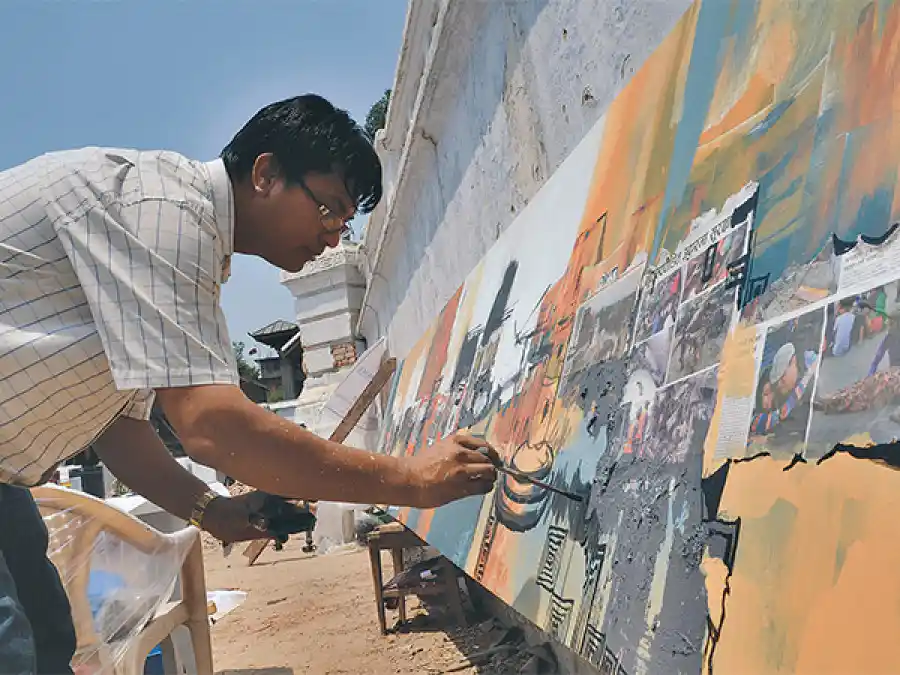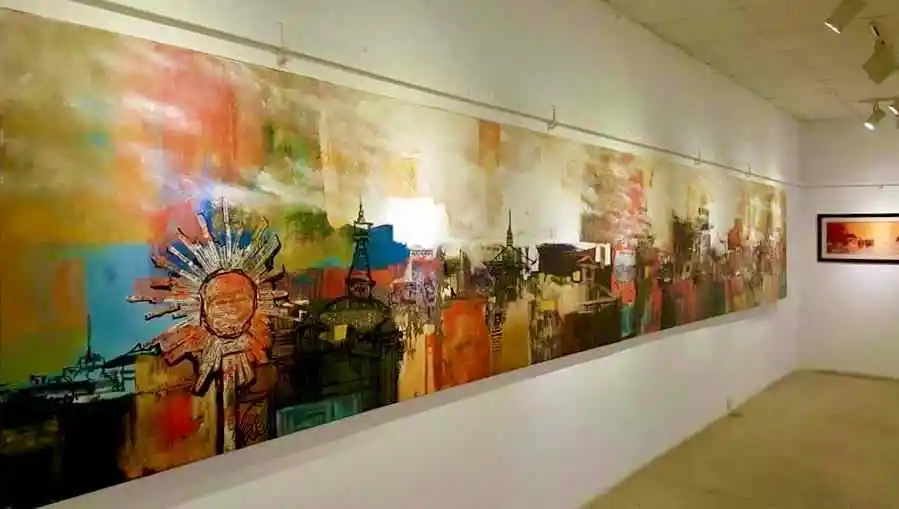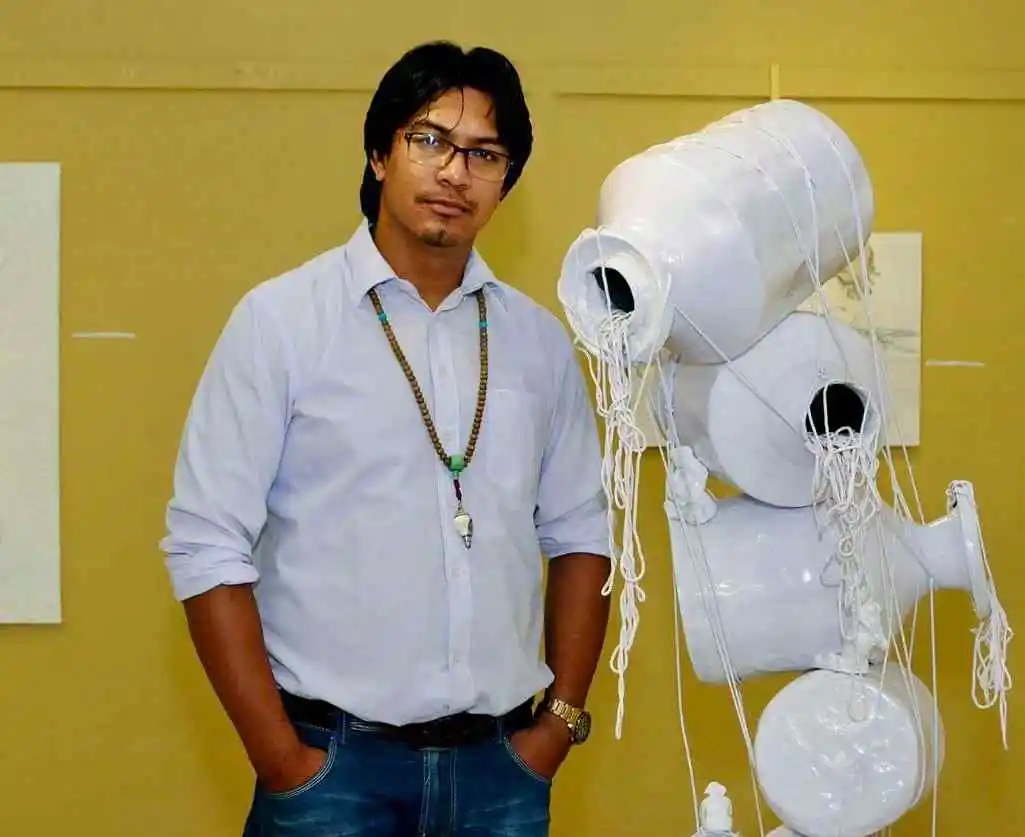
Jyoti Prakash creates white figures, images, symbols and shapes in the white background. How is it possible? The whites come in different shades. On the other hand, he uses the lumps of colors having three dimensions that project up from the surface. The concept of “white on white” communicates the idea that there is no essential difference between you and me. Your feelings and my feelings are universal. Both of us share the same dream. Hypocrisy, pride and artificiality separate you and me. You become bright and I become dim, you are loud and I am silent, or maybe vice versa. But this is only the drama; our essence is the same.
Foreground and background go hand in hand—visible and invisible, tangible and intangible. The white is also the symbol of purity and humbleness. You and me are together; no hierarchy of high and low. The artist connects the fragments in one string, bridges gaps so that one can communicate with other, one can exist in harmony with other. The artworks also relate Charles Darwin’s theory of “struggle for existence” and the phenomenon of camouflage. For your survival, you look like your background.
On the other hand, white is also associated with mourning, loneliness, sadness and non-existence. Why is the artist concerned with such motifs? Look at our time—cry, conflict, confrontation, clash, division, death, decay, fragmentation and brokenness. Shall we celebrate this time? Do we have colorful feelings? Of course not. We mourn with white dress. We remain silent. We take rest from action. The white is coherent with such situation.
What are the possibilities in such situation? Jyoti Prakash envisions calmness in chaos, coexistence in confrontation, union in division, regeneration in death and decay, holistic existence in fragmentation, brotherhood in enmity. We have divided the society into binary oppositions—female/male, Terai/mountain, lower caste/higher caste, remoteness/nearness, exclusion/inclusion. We are fighting for our superiority over others. We behave as if we were born to fight. The artist goes beyond these binary oppositions and tries to connect them with a string, brings two edges together with the help of buttons. We exist if we accept the existence of the other. The mandala with meditating Buddha, figure of White Tara, prayer flags, sign of swastika and decorative patterns of traditional Nepali art are coherent with the theme of peace, harmony, cooperation and coexistence.
Some of the artworks of Jyoti Prakash are critical comments on the contemporary context. Camels are going into the canvas and coming out of the canvas in the structure of a chess board. The fable is the analogy of foreign employment. Nepali youths play the game with enthusiasm and high spirit but they always lose the game along with their native nation. Fruitful and productive years are lost in foreign land. There is no production in the native land as the land remains barren. Even if they bring in money, the food may be scarce when the neighboring countries stop their exports. The country loses its independence. In addition to this, sometimes, the output is losing one’s wife and children, jail and torture, invalid body, and the coffin with dead body.
Jyoti also comments on the existing hypocrisy in Nepali society. Instead of “Aama (Mother),” the character calls her “My Mum,” becoming so-called modern. The mother’s condition is the same—she is confined within home, overloaded with water pitcher, cooking meal, washing utensils, conceiving baby, delivering baby and feeding children. But her name is changed from Nepali to English. Our belief is that imitating the West makes us modern—we copy western art, food, fashion, manner, education, religion and politics. We do not have self-confidence and faith in ourselves. Mixing English in Nepali, we make ourselves modern. This is the common pattern in all sectors of life and society.
The artworks come from his own experiences. The artist remembers his mother working in the field, planting paddy while the stars are shining in the sky, and carrying the loads of crops and fertilizer. At the same time, the son is waiting at home for the arrival of the mother. We can imagine the narrative of the country life. Each of his works is an individual being having independent existence and autonomous entity. The felt life has been presented in the art.
Jyoti Prakash’s artworks are experimental, for he does not follow the existing and established codes of art. He creates his own rules and techniques for his arts. His artworks carve a distinct space not only in the domain of Nepali art but also across the world.
The artist rereads Salvador Dali’s Persistence of Memory, Edvard Munch’s Cry and Vincent Van Gogh’s Starry Night, and reformulates them in Nepali context. He de-contextualizes and re-contextualizes remaining in the ambivalent space. He shifts from art for art’s sake to art for the world. In addition to the aesthetic pleasure, his works have relevant social messages. The context has influenced the artist, then the artworks attempt to influence society. The artist has the intuition and sparks within himself to change the world. His passion has pushed him toward unique creations.
The depth of the study, philosophical insight, matured craftsmanship, spontaneity of movement, true to oneself and self-confidence have given this height to Jyoti Prakash. Rhythm and music are the essential qualities of his artworks. The patterns of lines, images and shapes create a sense of movement and motion. Both of his personalities as a visual artist and musician are apparent in these artworks. The mélange of painting and sculpture explores the inter-art relationship. Three-dimensional things have been attached to the two-dimensional canvas. The texture arouses our tactile sensation. Furthermore, he brings real things like plates, bowls, kettles, ropes and buttons within the domain of art, conveying the sense that art should not be detached from life.
Dr. Yam Prasad Sharma
Art Critic